Research ·
A research team led by Zheng Yuchen publishes a paper at the top machine learning conference NeurIPS
Recently, the team led by Zheng Yuchen from the School of Information Science and Technology (School of Cyber Science and Technology) of our university has made new progress in federated spiking neural network research. Their paper, “Decoupling Label Shift and Surrogate Gradient Errors for Robust Federated Spiking Neural Networks” (Decoupling Label Shift and Surrogate Gradient Errors for Robust Federated Spiking Neural Networks), has been accepted by the Fortieth Annual Conference on Neural Information Processing Systems (NeurIPS 2026).
This study focuses on federated spiking neural networks for edge intelligence and investigates training robustness under non-independent and identically distributed data. It proposes the ST-SAT framework to mitigate the coupling of these errors through neuron adaptation and client–server knowledge alignment. The paper introduces two key mechanisms: the ST-PLIF neuron adaptively adjusts its firing threshold, membrane potential, and decay dynamics; dual-scale knowledge distillation combines prediction-layer knowledge transfer with alignment of neuronal statistical features to reduce class bias and differences in knowledge among clients. On three benchmark datasets, the method improves the performance of both the global model and local client models, particularly under severe label shift.
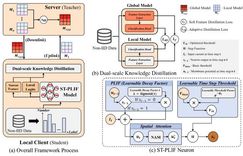
The Annual Conference on Neural Information Processing Systems (NeurIPS) is recognized as one of the most prestigious international academic conferences in artificial intelligence and machine learning and is a Category A international conference recommended by the China Computer Federation (CCF A). It has long brought together cutting-edge work from leading universities and research institutions worldwide in machine learning theory, neural networks, large language models, reinforcement learning, and other areas. Its review process is extremely rigorous, and it has substantial academic influence.
Master’s students Zouquan Chen and Yifei Yang from the School of Information Science and Technology (School of Cyber Science and Technology) are the co-first authors of the paper. Yuchen Zheng and Zhiming Fang are the corresponding authors.