
Recently, the research team led by Associate Professor Yuchen Zheng from the School of Information Science and Technology (School of Cyber Science and Technology) of our university has made new progress in the research on water‑body change detection of satellite remote‑sensing images. The relevant result, entitled FSSENet: A Foundation Model‑Based Semantic‑Structural Enhanced Network for remote sensing water body change detection, has been published in Pattern Recognition (CAS Q1 Top Journal, IF: 9.1).
Remote‑sensing water‑body change detection automatically interprets the dynamic changes of surface water bodies using bi‑temporal remote‑sensing images. This task faces many practical challenges: the semantic features of water bodies are complex and variable. Existing mainstream models can hardly fully capture the complex semantics and spatial continuity of water bodies, and their detection performance tends to degrade under diverse background interferences.
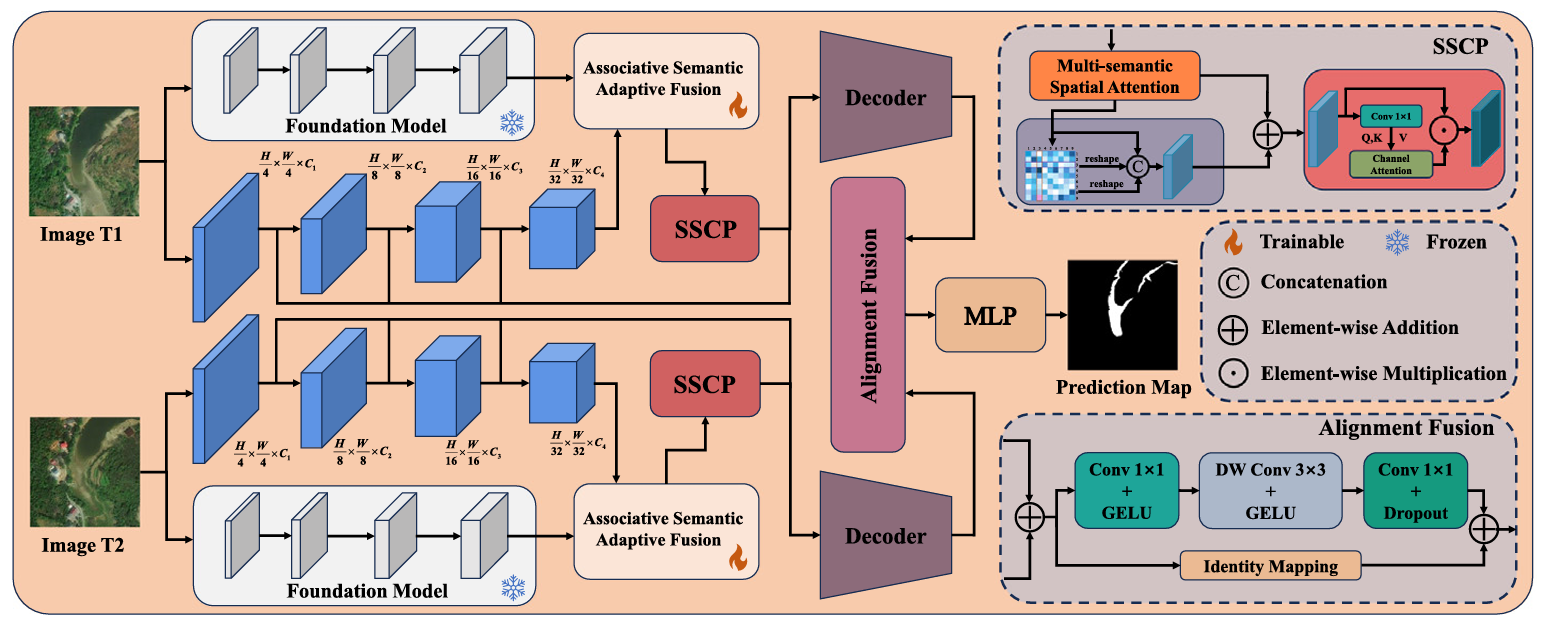
To address the above‑mentioned problems, this paper proposes FSSENet, a foundation‑model‑based semantic‑structural enhanced network for remote‑sensing water‑body change detection. The framework fully exploits the general semantic prior knowledge of foundation models and realizes the collaborative enhancement of semantic and structural information through task‑specific modules.
- A frozen foundation model is adopted to extract high‑level general features from bi‑temporal images and obtain complete semantic representations for complex water‑body change scenarios;
- The Associative Semantic Adaptive Fusion (ASAF) module is designed to strengthen feature responses in water‑body regions, which adaptively fuses with task‑specific features to transfer knowledge from foundation models to the water‑body change‑detection task;
- Spatial‑Semantic and Continuity‑aware Self‑Attention (SSCP) is introduced to further optimize fused features. It jointly models spatial‑semantic relationships and regional continuity to improve the semantic consistency and structural integrity of change regions.
Experiments on two benchmark water‑body change‑detection datasets demonstrate that the proposed method achieves better detection performance compared with mainstream algorithms. Ablation experiments verify the effectiveness of each core module and the generalization ability of the framework.
 FSSENet Overall Network Framework
 ASAF Associative Semantic Adaptive Fusion Module
This paper is co‑first‑authored by PhD candidate Haoran Wang and master student Quanqing Ma. Associate Professor Yuchen Zheng serves as the corresponding author.