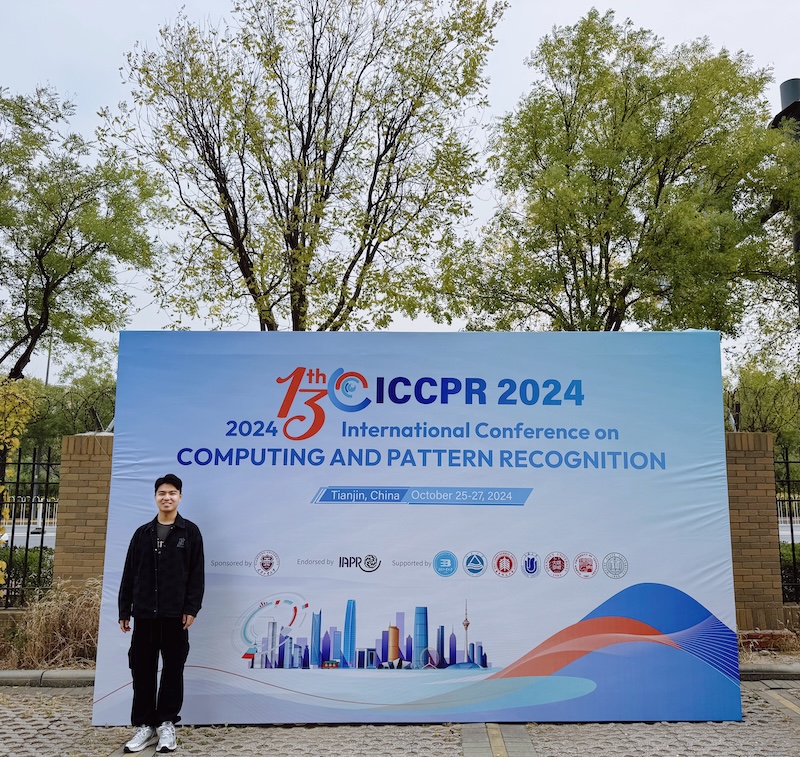
The Pattern Recognition and Machine Learning Laboratory of Shihezi University achieved important academic outcomes at ICCPR 2024. Two innovative papers from the laboratory were accepted for oral presentation, demonstrating the team’s in‑depth research in offline signature verification. Under the supervision of Associate Professor Yuchen Zheng, master students Lidong Zheng and Qifeng Zhu conducted research on signature local‑feature modeling and deep‑feature subspace optimization respectively.
Lidong Zheng proposed the Signature Local Feature Reconstruction Module (SLFRM), which innovatively designed the Local‑Spatial‑Feature Unit (LSFU) and Local‑Spatial‑Attention Unit (LSAU). Through a dynamic weighting mechanism, it strengthens the learning of discriminative local differences in signature images and addresses the insufficient capture of subtle features in traditional methods. Qifeng Zhu’s research focused on discovering optimal subspaces in deep architectures. By collaboratively optimizing random high‑dimensional projection and Linear Discriminant Analysis (LDA), discriminative scaling of signature features in arbitrary subspaces is realized, offering new ideas for identity authentication under complex scenarios.
During the conference, lab members had in‑depth exchanges with domestic and overseas scholars on cutting‑edge topics such as deep learning and feature representation. These results not only reflect the lab’s research strength in pattern recognition, but also lay an important foundation for subsequent cross‑modal biometric recognition research.
Conference Presentations
SLFRM: A Novel Signature Local Feature Reconstruction Module for Offline Signature Verification
Master student Lidong Zheng presented his paper “SLFRM: A Novel Signature Local Feature Reconstruction Module for Offline Signature Verification”. He proposed a novel Signature Local Feature Reconstruction Module (SLFRM), which assigns weights to feature maps to capture and emphasize subtle local‑spatial differences among different signatures. Specifically, SLFRM consists of two components: the Local‑Spatial‑Feature Unit (LSFU) for extracting receptive‑field spatial features of signatures, and the Local‑Spatial‑Attention Unit (LSAU) for generating receptive‑field spatial attention maps. Final local reconstructed features are produced via standard convolution operations. The module redistributes weights for input features and assigns higher weights to features with stronger discriminative power, so that the model prioritizes learning subtle difference features in the feature‑learning stage.
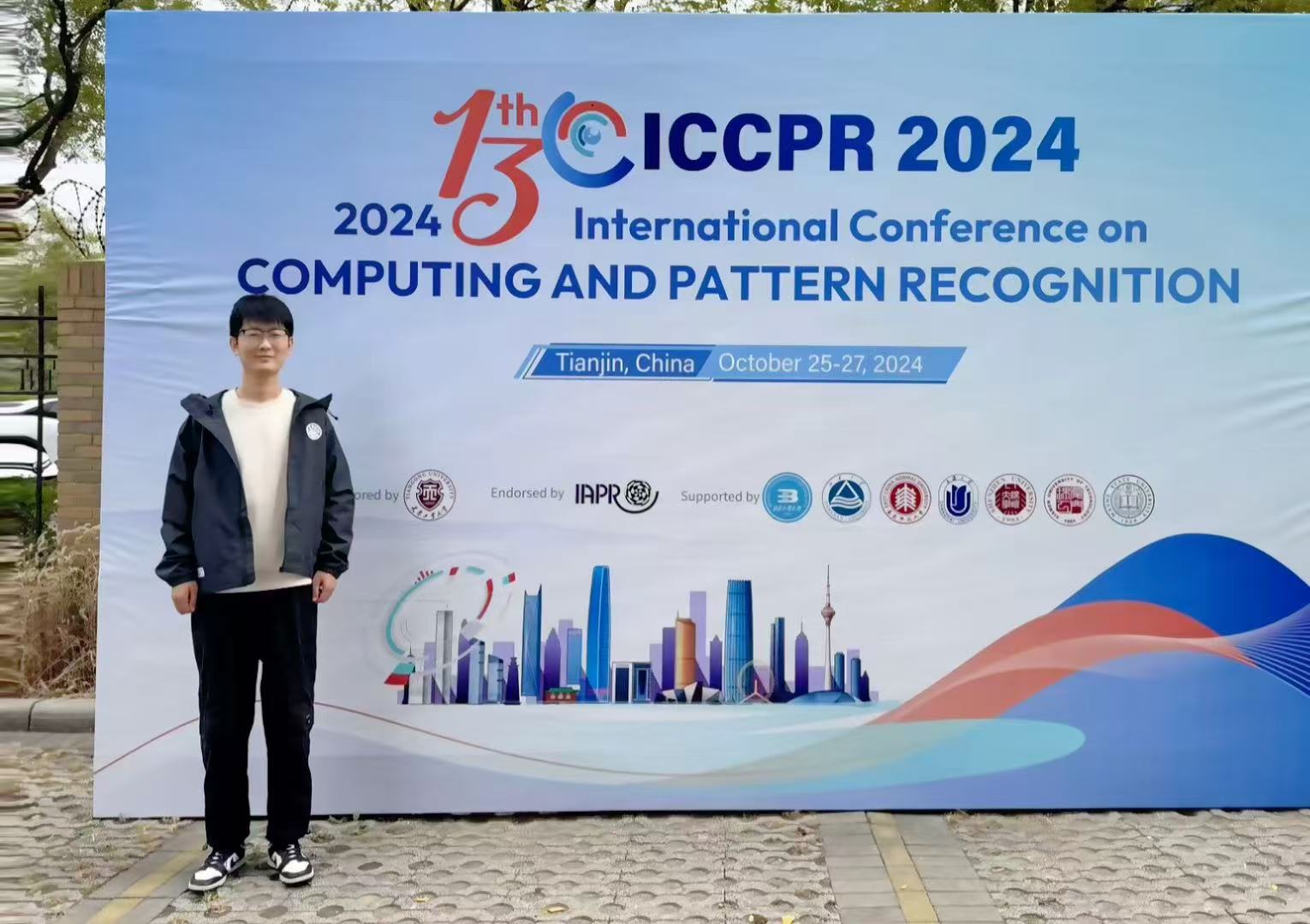 Participant: Lidong Zheng
Discovering Optimal Subspaces in Deep Architectures for Offline Signature Verification
Master student Qifeng Zhu presented his paper “Discovering Optimal Subspaces in Deep Architectures for Offline Signature Verification”. He proposed a novel framework that controls feature dimensions by stretching and dimension‑reducing deep features to obtain optimal representations. Deep features are stretched using a high‑dimensional projection matrix whose elements are randomly sampled from the standard normal distribution to obtain more discriminative representations. Linear Discriminant Analysis (LDA) is further adopted for dimension reduction to effectively capture subtle differences between different signers. The learned features can be scaled into any optimal subspace.
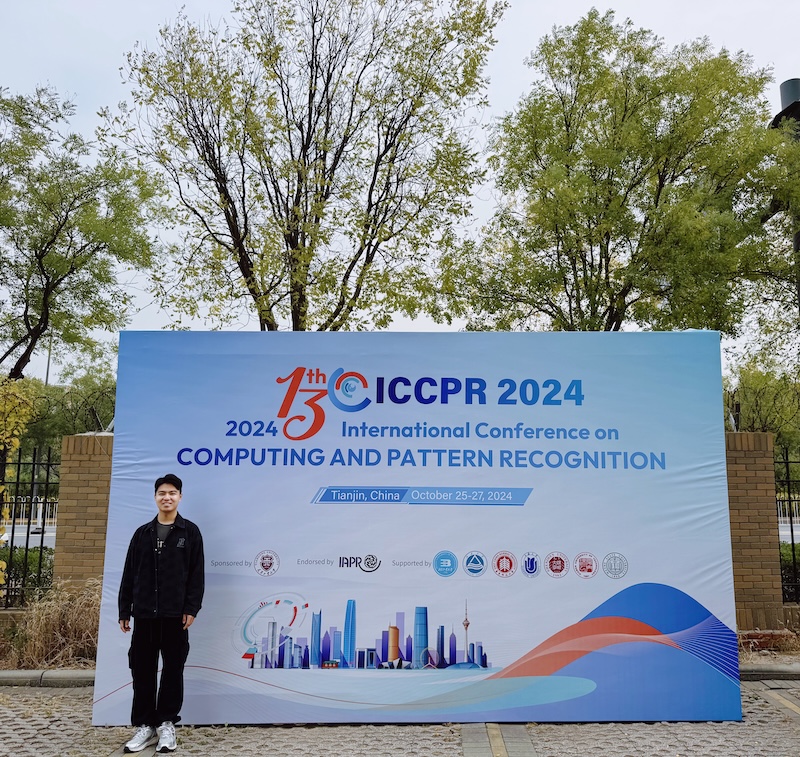 Participant: Qifeng Zhu
Conference Outcomes
Lab participants actively communicated with other attendees at the conference, fully demonstrating the fine academic style and research atmosphere of the Pattern Recognition and Machine Learning Laboratory at Shihezi University.